
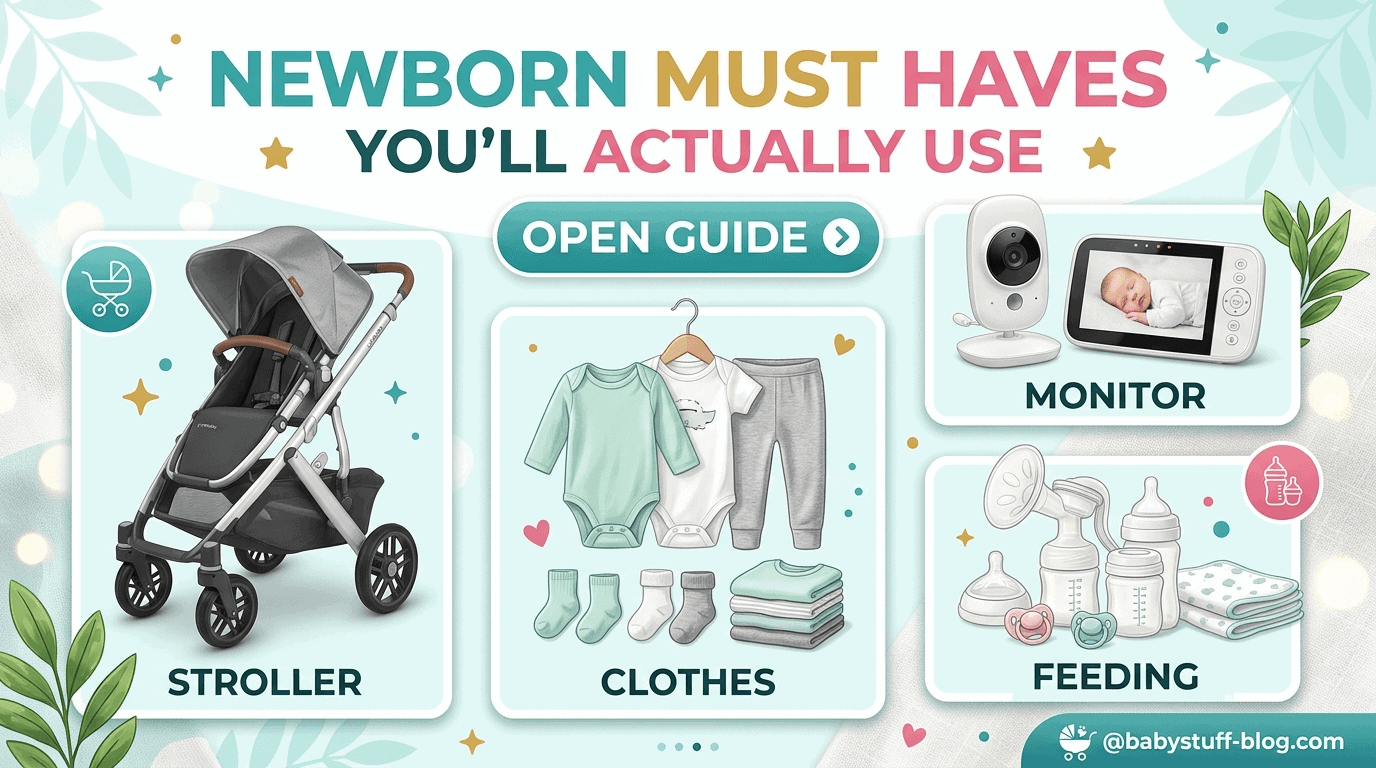
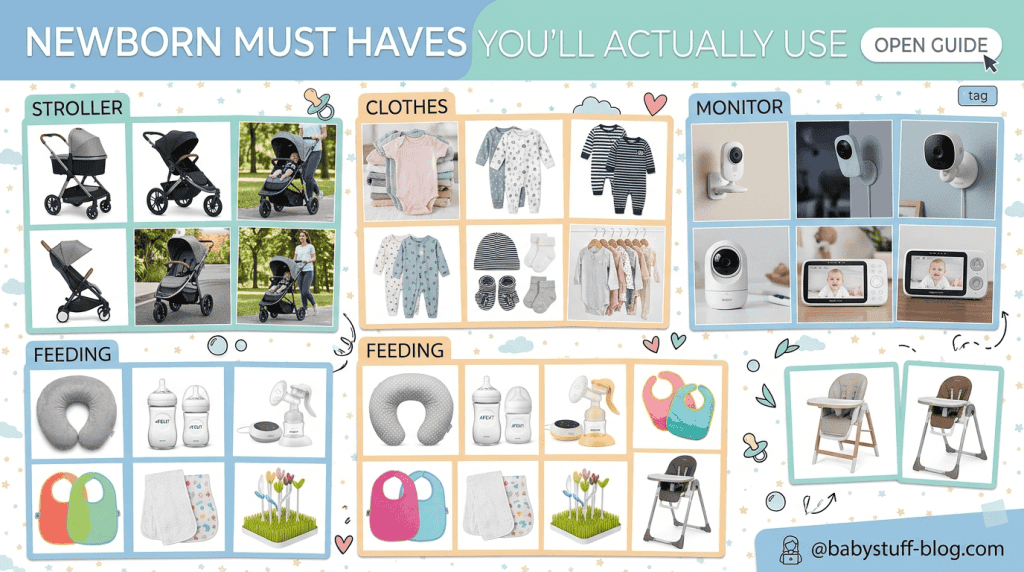
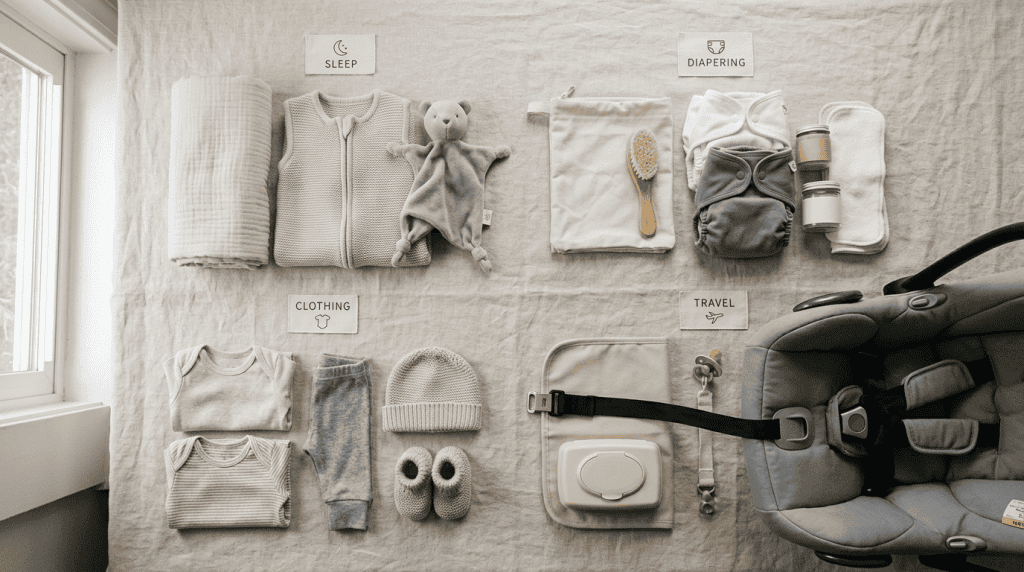
The best newborn checklist is short, safety-first and organized around real care moments: sleep, feeding, diapering, clothing, travel and recovery. Buy the basics first; add specialized gear only after you know your routine.
A practical newborn checklist that separates must-have, useful and skip items.
Start with the everyday need
A newborn checklist becomes overwhelming when every product is presented as urgent. The first weeks are usually about a small number of repeated tasks: a safe place to sleep, clean diaper changes, feeding support, a few clothing layers and getting home safely. The useful question is not how to buy everything before the due date. It is what will make those ordinary, exhausting moments easier without filling the house with gear that never gets used.
Use this page as a decision guide. Separate Must have, Helpful if it solves a real problem, Buy later and Skip for now. That structure gives a new parent permission to start small and still gives a commerce reader clear product categories to compare.

- Start with the real household need.
- Separate time-critical purchases from later preferences.
- Make safety and returns part of the buying decision.
- Keep affiliate products secondary to the explanation.

What belongs on the shortlist
Start by sorting the decision into a few product categories. Every category earns its place only when it solves a real task, has a realistic use case and comes with a clear boundary. You should be able to remove an item from the list without feeling that you are failing as a parent.
When you turn this draft into product cards, put the use case, safety/return note and fit boundary before the affiliate link. That order keeps the guide useful even when a retailer changes stock or a reader chooses another brand.
| Category | What to look for | Why it matters |
| Safe sleep space | Firm, flat sleep surface and fitted sheet | The sleep area should stay clear and follow current safe-sleep guidance |
| Diapering | Diapers, wipes or cloths, changing mat | A simple station prevents repeated trips during the day |
| Feeding support | Bottles/pumping or nursing support as relevant | Needs differ; avoid assuming one feeding plan |
| Clothing | Several easy-to-wash layers in more than one size | Newborns grow quickly and laundry changes the quantity |
| Travel home | Correctly installed car seat and a simple bag | Time-critical before leaving the hospital |
| Parent recovery | Water bottle, easy snacks, comfortable basics | Care for the caregiver is part of practical newborn preparation |
How to compare products without getting lost
A trustworthy roundup explains tradeoffs instead of rewarding the longest feature list. Weight, size, cleaning, compatibility, subscription, return policy and support often matter more than one extra function. Use the comparison below to decide what deserves a product card, then verify each live model against the current manufacturer and retailer page.
There is no product that is best for every family. Match the recommendation to a situation and name the limit. A parent can then choose, compare or wait without being pushed into a purchase that does not fit the household.
| Decision point | Question | Editorial rule |
| Product area | Compare | Do not assume |
| Sleep | Fit, instructions, cleaning, safety notices | A monitor or accessory makes sleep safer |
| Diapering | Height, wipeability, storage and standing height | The most expensive station is best |
| Clothing | Openings, fabric, washability and size | One brand’s size fits every baby |
| Car seat | Vehicle fit, installation and expiry guidance | A product is safe without a fit check |
Safety boundaries every newborn guide must make explicit
Sleep, transport, feeding and products with small parts deserve more than a cheerful product description. Follow current CPSC/AAP guidance, manufacturer instructions and local pediatric advice. Do not recommend loose bedding, inclined sleep products or accessories as comfort shortcuts. A consumer monitor is not a medical device and does not prevent SIDS.
Keep general information separate from medical advice. Link to current official guidance for sleep, safety or connected devices and date-stamp the review. If a product has a recall, missing instruction or unclear age limit, remove it from the recommendation until the issue is resolved.
- Loose sleep accessories, positioners or products marketed as a sleep solution without current safety support.
- Large quantities of one newborn size before you know the baby’s growth and laundry pattern.
- Unclear car-seat fit, used gear without a known history or products with missing instructions.
- A long list of gadgets that has no connection to a real daily problem.
Test the decision in a normal day
Before checkout, run the product through the moment it is supposed to improve. Where will it live? Who will use it when tired or in a hurry? Can it be cleaned, adjusted, returned or stored? What happens when the baby grows, the season changes or the family’s routine differs from the product description? These questions expose weak recommendations quickly.
For gift pages, apply the same test from the recipient’s perspective: is the size known, is the item wanted, can it be exchanged and does it create more work? For gear pages, add a short hands-on test and an explicit stop condition. This turns a product list into advice a parent can act on.
| Real-life moment | Question to answer | Useful result |
| First use | What must work immediately? | Small starter set |
| Cleaning | What gets dirty and how fast? | Care/quantity decision |
| Change | What if size, season or routine changes? | Return or buy-later rule |
| Support | Who can help if setup is unclear? | Manufacturer/contact check |
A calm purchase plan for the reader
This is the part that turns Pinterest curiosity into a saved, useful page. Follow the sequence instead of building one huge shopping cart. Complete the time-critical step first and postpone the rest until the real routine is visible. That reduces buyer’s remorse and leaves room for the products that genuinely help.
A printable checklist can repeat the decision fields, not just the affiliate product names. It gives readers something useful to save, share and return to after the first weeks.
Add specialized gear only after a real routine reveals a need.
Set up the safe sleep and diapering basics first.
Choose a small clothing rotation in two adjacent sizes.
Install and test the car seat before the due date.
Buy feeding items for the plan you actually expect, while keeping flexibility.
For products used during sleep, feeding, transport or around small parts, follow current safety guidance and the manufacturer’s instructions. Avoid absolute language such as safest, best for every baby or guaranteed to improve sleep.
| Decision point | Question to answer | Add before publishing |
| Fit / age | Is the item appropriate for the child’s stage? | Current size and age guidance |
| Care | Can it be washed or cleaned as needed? | Care instructions and materials |
| Safety | Are there warnings, recalls or setup limits? | Official safety/recall link |
| Use | Does it solve a real daily problem? | Short use-case example |
| Value | Will it be used often enough? | Price and return check |
Buy now, consider later, skip for now
The most honest recommendation is often to buy less. Newborn routines change quickly, and a product that looks essential in a registry may be unnecessary in a small home or for a family with support nearby. Keep gift and affiliate links secondary to the decision logic.
Add a short checklist at the end: confirm fit, read the instructions, check current recalls, keep the receipt and reassess after a few weeks. This makes the article useful after the purchase, not only at the moment of the click.
- Buy now: the small set required for safe care and everyday logistics.
- Consider later: specialized equipment that depends on routine, space or personal preference.
- Skip for now: duplicates, novelty items, unsafe sleep accessories or products with unclear instructions.

Safety note for families
This guide is general information, not medical advice. Follow local pediatric guidance, product instructions and current safety notices. For sleep, use a safe sleep space and do not treat consumer monitors or comfort products as a medical solution.
FAQ
How many newborn essentials do I really need?
Start with a small core for sleep, diapering, feeding, clothing, travel and parent recovery. Laundry, season, feeding plan and support change the quantity.
What should I buy before the baby arrives?
Prioritize the safe sleep space, a tested car seat, basic clothing, diapering supplies and the items needed for your expected feeding situation.
Are baby monitors a safety device?
No. A consumer monitor does not prevent SIDS and does not replace a clear sleep space, direct care or medical advice.
When should I buy specialized baby gear?
After the daily routine shows a real need, unless the item is time-critical for safe travel or care.