
A screen-free travel kit for toddlers works best when it contains a few familiar activities and a clear plan for where to use them. Keep moving-car entertainment simple, then save drawing and hands-on play for a table or a safely parked stop.
This guide focuses on children roughly ages one to three. Product age labels still apply: a toy marketed for preschoolers is not automatically suitable for a younger toddler, even with an adult nearby.
Disclosure: As an Amazon Associate I earn from qualifying purchases. I may receive a commission when you buy through the paid links in this article, at no extra cost to you.
Start with three jobs rather than ten toys
Give the kit three jobs: something familiar to look at together, something to talk or sing about, and something to do at a stop. You can cover several of these without buying anything.
Pick items your toddler has used at home. A long journey is an awkward time to introduce an activity that needs lots of explanation or has pieces that disappear under the seat.
Use the smallest bag that comfortably holds the chosen activities. If it is difficult to close, remove something before buying a bigger bag.
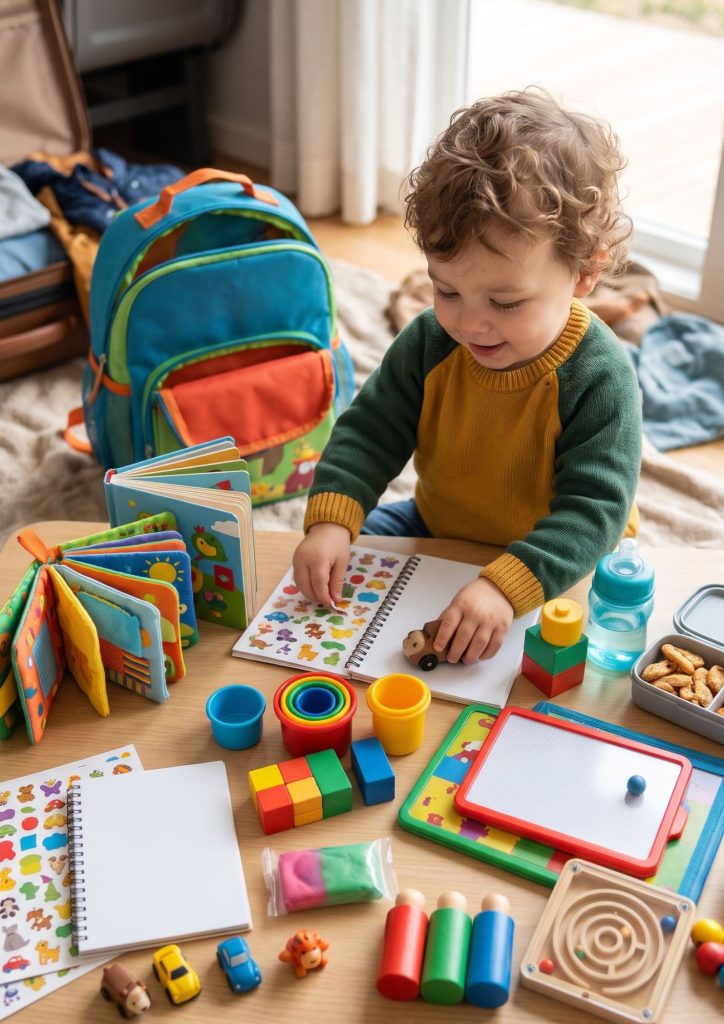
For the drive prioritize voice and simple interaction
Prepare familiar songs before departure. A passenger can sing a short line and pause for the toddler to finish it, make animal sounds or talk about things the child notices. The driver does not need to lead the game.
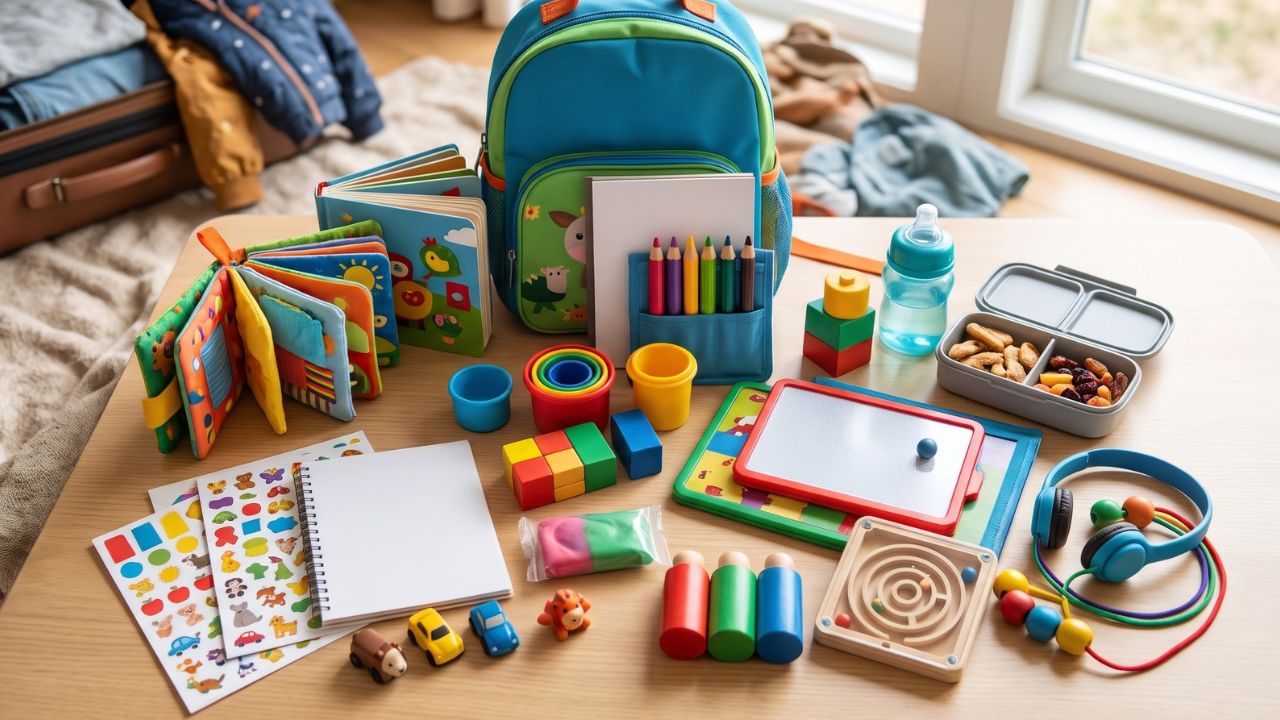
A Manhattan Toy Mini Apple Farm soft book (paid link) is an example to compare if you want a fabric book for shared awake play. Inspect the exact item and use it according to its instructions. It is also useful at a stop, so you do not need a separate item for every setting.
For solo driving, prepare any audio in advance and pull over safely if your child needs help. Avoid activities that require the driver to pass back supplies or retrieve dropped pieces.
Do not attach toys or storage systems to a car seat without checking its instructions. A product being sold as a travel accessory does not establish compatibility with your particular seat.
For a stop pack one book and one action
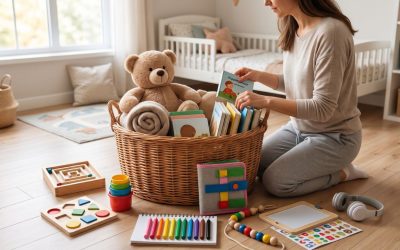
A familiar toddler board book (paid link) can become several short games at a stop. Find an animal, copy its sound, point to something red or let your child turn the pages. Borrowing from your library is an equally useful option.
For hands-on play, a few baby stacking cups (paid link) can be stacked, nested or used to hide a large toy at your destination. Check the exact set’s age guidance and inspect it for damage. Keep cups on a stable surface away from vehicle traffic.
Choose an action your child already enjoys. A toddler who likes knocking down towers may get more use from a few cups than a complicated activity book with fasteners they cannot yet manage.
For a table add supervised mark making
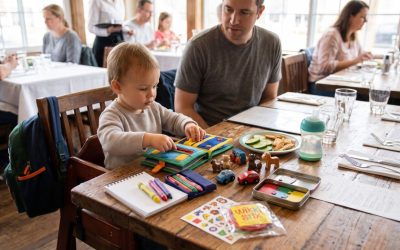
Crayola Palm Grasp washable crayons (paid link) are an option for a child who meets the exact product’s age guidance and is ready for supervised drawing. Use them with plain paper at a table during a stop or at your destination.
Offer two colors instead of the whole pack. You can draw a road and let your toddler add marks, trace around a cup or simply scribble together. Keep crayons away from a child who is chewing or breaking them.
Do not turn a parked-car activity into a moving-car recommendation just because it fits inside a pouch. Tables, hands-on adult help and the ability to retrieve dropped objects change how usable an activity is.
Use the child’s response as your cue
There is no universal activity interval that every toddler should meet. If your child is quietly watching the scenery, you do not need to interrupt with another toy. If an activity is frustrating, pause or change it.
Try this loose sequence: familiar song, quiet observation, conversation with a passenger, then a proper stop when needed. At the stop, offer a book or table activity after care needs have been handled.
For an infant sibling, feed, changes and rest take priority over participating in the toddler’s entertainment. Keep the two children’s supplies separate.
Leave these items out
Skip loose magnets, button-battery activities, tiny puzzle pieces, beads and other small parts. The CPSC toy-safety guidance is a useful starting point when checking packaging and age suitability.
Avoid presenting a kit as a guarantee against crying, boredom or meltdowns. It gives you options; it does not remove the need for breaks or responsive care.
Questions parents ask
Is a screen-free kit useful for a short trip
Yes, but it can be much smaller. One familiar item and a few songs may be enough. Leave the destination supplies packed unless you need them.
What if my toddler rejects every activity
Check basic needs and stop safely when necessary. Repeatedly offering more toys may add frustration rather than solve the problem.
What about activities for an older sibling
Use its older-child ideas selectively and check suitability for each child. For more ideas at home, try our toddler quiet-time basket.